
Squeezing through a narrow doorway and maneuvering my oversized backpack into a space less than a metre wide, an old African proverb comes to mind: “A diamond is a diamond, no matter how small.”
This particular gem is a perfectly-formed capsule bed in London’s newest Japanese-style pod hotel, Otherwander.
The moment I settle into this warmly lit, freshly scented, and futuristic “nest”—as they are called at Otherwander—I know I am going to sleep soundly.
This is not my first experience with pod-style accommodation.
As one of the thousands of weekly commuters to London, often referred to as a “TWaT” (someone who works Tuesday, Wednesday, and Thursday), my search for a bed under £100 has led me to a hostel dorm in London Bridge with a leaky roof and a bucket (£26 per night); a hot, cramped, and dirty Airbnb room in Chiselhurst infested with lice during a heatwave (£65 a night); and a variety of lackluster single rooms, usually in basements, around Paddington, King’s Cross, and Finsbury Park that barely met my budget.
I recently stayed in one of central London’s cheapest and busiest pod hotelspage.com/the-best-hotels-in-nice-for-every-budget/” title=”The best hotels in Nice, for every budget”>hotelspage.com/here-are-the-10-best-hotels-in-the-u-s-for-2026-according-to-a-new-trusted-report/” title=”Here are the 10 best hotels in the U.S. for 2026 according to a new trusted report”>hotels, which felt more like a coffin than a cocoon.
Consequently, I did not expect to find my favorite London stay—and my best night’s sleep yet—in Soho, arguably the trendiest but also one of the most expensive neighborhoods in England.
To anyone walking down Dean Street, it is clear that Otherwander stands out, with its neon-lit screen and airport-style perspex barriers illuminating a beautiful historic building.
Since I had discovered and booked the hotel on Booking.com that morning for just £65, I already felt like I had struck gold.
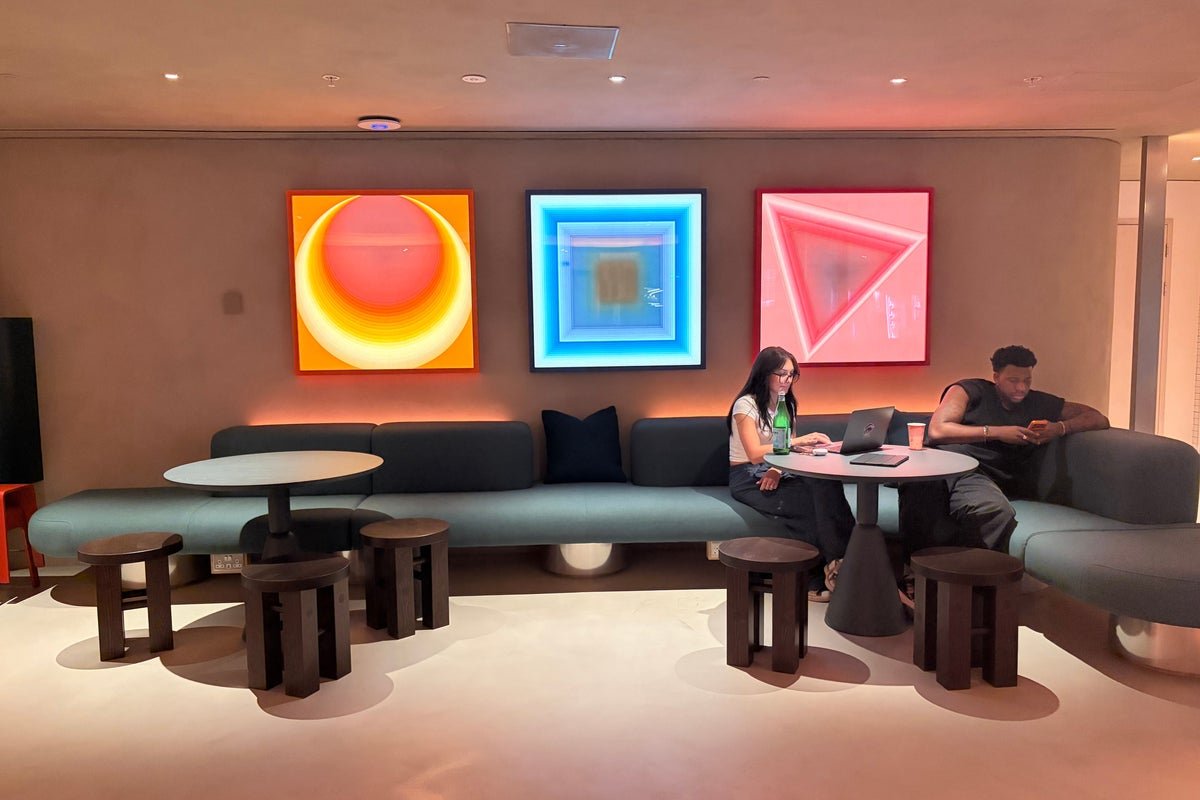
With a QR code sent to my phone upon booking, I bypassed the reception desk entirely. I simply held my phone to the scanner, passed through the barriers, and entered a stylish, dimly lit, modern communal area where half a dozen people—ranging from their early twenties to late fifties—were busy typing on laptops or checking their phones.
I took the lift upstairs, joined by three travelers in their twenties and a businessman in a suit. Upbeat jazz music put me in a good mood before I even reached my bed.
On the second floor, I located my room number and scanned my phone’s QR code again to unlock the door. I was met with a sleek blue-and-white corridor lined with tiny, hobbit-sized doors.
My “room” consisted of a mattress inside a cabin measuring two metres long by 90cm wide. Once I left my shoes by the entrance and climbed inside, it was surprisingly comfortable.
Inside, a digital display allowed me to adjust the lighting and temperature to my exact preference—19 degrees with a warm orange glow. The air felt fresh, perhaps because the facility is only a few weeks old, though I was told the air is piped in from outside rather than recirculated.
There is a small luggage rack, a mirror, charging sockets, and even a hanger for my work clothes. I organized my outfit for the next morning and climbed out of the pod to shower, using the fresh, complimentary towel provided.
In the bathroom, I encountered a man in his underwear—these are mixed-gender pods with shared facilities, so you must be prepared to see others—and a row of rain showers stocked with shampoo and body wash.
I woke up the next morning feeling like I had enjoyed the best sleep in years.
It requires a bit of contortion to get dressed and pack my belongings in such a confined space, but it is a small price to pay.
I headed downstairs to the communal area. It was 6.30am, yet I found Fredrik Korallus, the Swedish CEO of Otherwander, working on his laptop. Six weeks after opening, he is still getting to know his guests.
“When we acquired this site, it was the highest rated hostel in London – Soho Hostel,” he tells me.
“We studied pod hotels in Japan in the 1970s and they were for the working man. We thought it was ideal for London to make accommodation accessible and affordable.
“We are getting businesspeople, global backpackers, city hoppers, commuters. Picking up a lot of people on the day and then getting repeat people. I just love it because we’re allowing a younger generation to get access to London.
“In a regular hotel room you get a lot of facilities, but you don’t use them. You use one towel, you sleep in one bed. We are trying to give you everything you need in a small space. It’s deconstructed hospitality.”
He has ambitious plans to expand that hospitality, with another London site in the works and a team exploring opportunities in New York, Edinburgh, and Amsterdam.
I checked out the same way I checked in, walking straight through the perspex doors using my QR code. It was like an airport without the queues. I floated into work, well-rested and prepared for the week ahead.
Rooms at Otherwander start at £65 per night.
Do you run tours or sell travel packages in London? Advertise here.